

Beyond the Big Dipper: Discovering All Star Constellations
Why Understanding Constellation Stars Opens the Universe
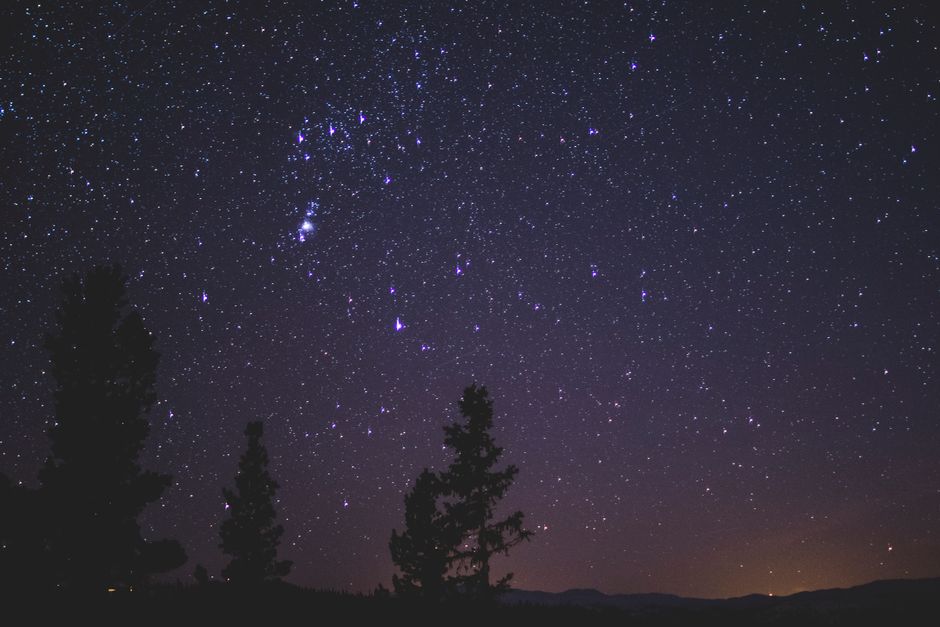
Constellation stars are the patterns of stars in the night sky that have guided travelers, inspired myths, and mapped the heavens for thousands of years. Here's what you need to know:
- 88 official constellations are recognized by the International Astronomical Union (IAU)
- Constellations are regions of the sky, not physically connected groups of stars
- Visibility changes based on your location, time of year, and time of night
- Stars in constellations are often hundreds of light-years apart from each other
- Asterisms (like the Big Dipper) are recognizable patterns within constellations
- Both astronomy and navigation use constellation stars as fixed landmarks
Trying to make sense of those countless stellar specks overhead might seem intimidating, but making friends with the stars needn't be a "mission impossible." Think of it like walking into a new classroom—at first, you see a room full of unfamiliar faces, but after spending time there, you start recognizing people and forming connections.
The same principle applies to constellation stars. Once you learn a few easy-to-find "guidepost" constellations like Orion the Hunter or the Big Dipper, the rest of the night sky begins to fall into place. You'll find how Orion's Belt points directly to Sirius, the brightest star in the night sky, or how the Big Dipper's handle "arcs to Arcturus" in the spring.
Whether you're searching for a meaningful way to commemorate a special moment under the stars or simply want to understand what you're looking at when you gaze upward, learning constellation stars connects you to something timeless. These same patterns guided ancient sailors across oceans, inspired countless myths and stories, and continue to help NASA spacecraft steer through space today.
I'm Suchi Jain Saxena, and while my background is in scaling businesses and creating personalized jewelry that captures life's precious moments, I've always been fascinated by how constellation stars help us mark and remember the moments that matter most. This guide will walk you through everything you need to know to start your own journey into the night sky.
Find more about constellation stars:
What Are Constellation Stars? Connecting the Celestial Dots
When we talk about constellation stars, we’re talking about star patterns that people connected into shapes and named long before city lights existed. Today, astronomers use constellations as official, mapped-out “neighborhoods” in the sky.
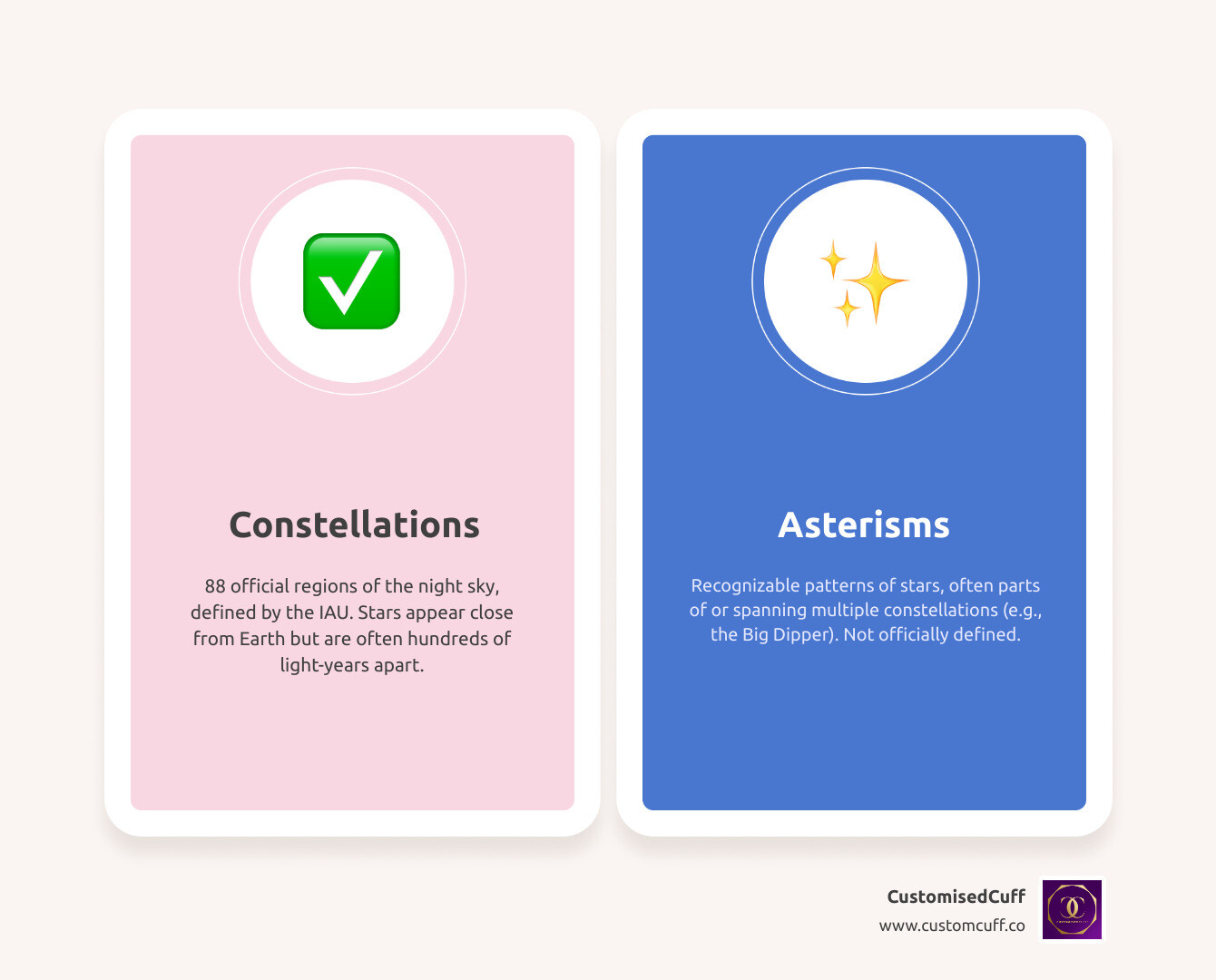
- The sky is divided into 88 official constellations, standardized by the International Astronomical Union (IAU). See the full list here: IAU designated constellations.
- A constellation is not just a picture—it’s an entire region of sky with boundaries, like countries on a globe. Any star, cluster, or galaxy inside that region “belongs” to that constellation.
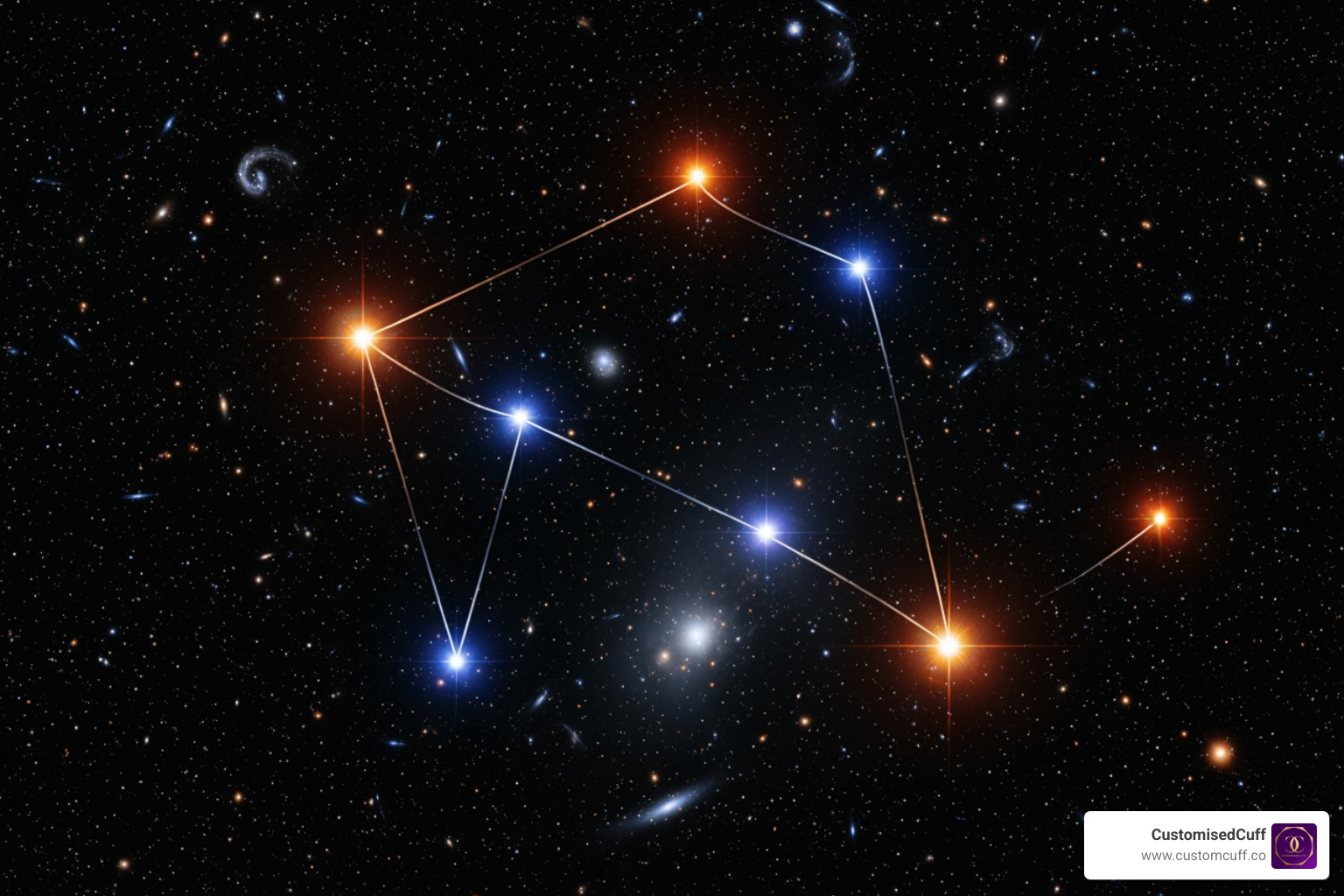
- The stars that make up a pattern almost never live near each other. They only appear grouped from our vantage point on Earth, sometimes separated by hundreds of light-years.
- Some patterns are famous but not official constellations. These are called asterisms (more below).
If you’re just starting out, we recommend beginning with a few easy patterns and then “connecting the dots” across the sky. Our starter guide can help: Connecting the Dots: A Beginner's Guide to Constellations.
For deeper reading and monthly highlights:
- NASA’s overview: Constellations
- EarthSky’s constellation library: Constellations | EarthSky
- Reference index: List of constellations
The Difference Between Asterisms and Constellations
Not every familiar star shape is a full-fledged constellation.
- The Big Dipper is an asterism within the constellation Ursa Major. It’s one of the best guideposts for northern observers in the USA, UK, Europe, Canada, and beyond.
- The Summer Triangle is another asterism linking three bright stars across three constellations: Vega (Lyra), Deneb (Cygnus), and Altair (Aquila).
- The Great Square of Pegasus is a large diamond-shaped asterism that marks the autumn sky in the Northern Hemisphere and helps you hop to the Andromeda Galaxy.
For a crisp explainer, see NASA’s primer: What Are Asterisms?
How are constellation stars officially defined?
- The International Astronomical Union (IAU) established the current boundaries in the 20th century, defining the 88 constellations that cover the entire sky.
- Astronomers use a celestial coordinate system (right ascension and declination) to locate objects within those borders.
- Constellation names come from Latin and carry stories from many cultures. While we honor the histories, astronomy itself focuses on observation, measurement, and evidence.
- Naming conventions use constellations as sky “addresses.” For example, meteor showers are named for the constellation where meteors appear to radiate: the Perseids (Perseus) and Orionids (Orion). NASA’s overview offers clear examples: What Are Constellations? | NASA Space Place
The Ever-Changing Sky: Why Constellations Shift
If you’ve ever wondered why Orion shows up in some months and vanishes in others, here’s the simple truth: Earth moves.
- Earth’s rotation makes the sky appear to spin each night, rising in the east and setting in the west.
- Earth’s orbit around the Sun changes which slice of the cosmos we face at night throughout the year. That’s why certain constellations are “seasonal.”
- Your location changes your view. In the Northern Hemisphere (USA, UK, Europe, Canada), Ursa Minor and Cassiopeia are circumpolar—visible all year if you’re far enough north. In the Southern Hemisphere (Australia, New Zealand, Brazil), other circumpolar constellations take center stage, and famous southern sights like the Small Magellanic Cloud (in the constellation Tucana) are visible.
Curious how your birth moment relates to the sky? We unpack the sky’s path in our guide to zodiac-inspired keepsakes: Wear Your Stars: A Guide to Choosing the Perfect Birth Chart Necklace
The Zodiac Constellations
- The Sun appears to trace a path through the sky called the ecliptic, crossing 13 constellations (yes, including Ophiuchus).
- Astronomy vs. astrology: In astronomy, zodiac constellations are simply those along the ecliptic. Astrology is a belief system that assigns meaning based on celestial positions; astronomy relies on evidence and the scientific method.
- If you enjoy symbol and story alongside science, explore our zodiac collection starting here: Celestial Charm: Discover Your Perfect Cancer Zodiac Sign Necklace
A Seasonal Guide to Stargazing
Here’s how we like to explore the sky, whether we’re in New York, Los Angeles, North Las Vegas, London, Lisbon, Mexico City, São Paulo, Doha, Auckland, or Sydney:
- Start with a guidepost pattern you can’t miss, then “star-hop” to fainter constellations.
- Use a mobile app or printable star map for your location.
- Get away from light pollution if you can; darker skies reveal fainter patterns like the Little Dipper.
- Give your eyes 20–30 minutes to adjust to the dark.
- Bring binoculars; they transform clusters like the Pleiades and reveal nebulae as misty glows.
Helpful tools for our communities:
- New York sky tonight: timeanddate.com/Night Sky – New York
- Los Angeles planetarium view: TheSkyLive – Los Angeles
- North Las Vegas planetarium view: TheSkyLive – North Las Vegas
Our beginner-friendly walkthrough: Starry Night Survival Guide: Spotting Night Sky Constellations
Winter's Brilliant Sky
Northern Hemisphere winter (Dec–Feb in USA, UK, Europe, Mexico, Qatar) brings the most spectacular showcase:
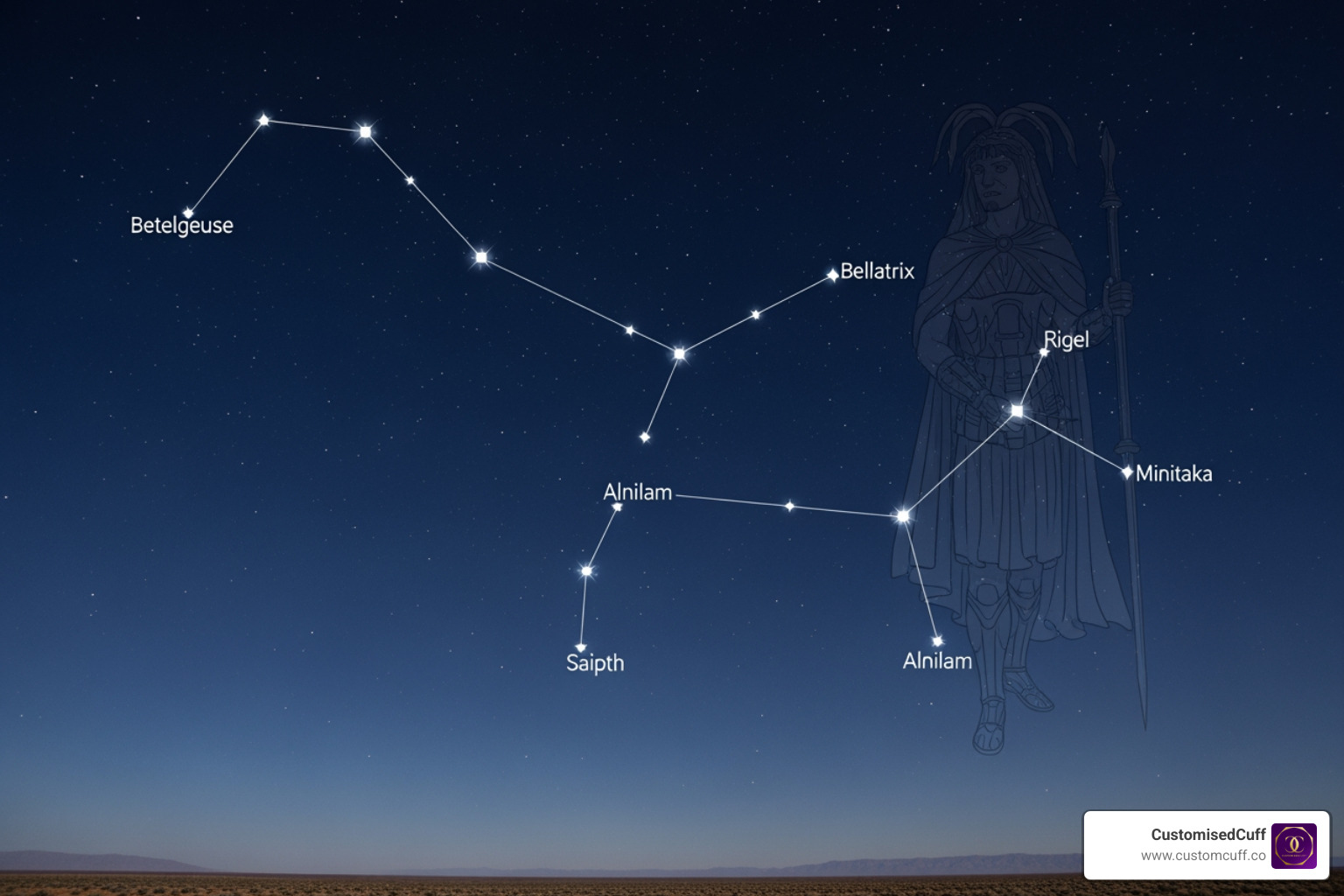
- Orion the Hunter: Often called the grandest constellation, it dominates the winter sky. Look for Orion’s Belt, a diagonal row of three bright stars.
- Hanging from the belt is Orion’s “sword.” The “middle star” is actually the Orion Nebula (M42)—a stellar nursery where new stars are born.
- Follow Orion’s Belt downward (southeast) to Sirius in Canis Major, the brightest star in the night sky. On some nights near the horizon, you’ll see it sparkle with colors due to atmospheric refraction.
- Look west of Taurus to spot the Pleiades (M45), the Seven Sisters. It’s a brilliant naked-eye cluster and breathtaking through binoculars.
- Don’t miss Capella in Auriga, one of the sky’s brightest stars, rounding out the winter parade.
Southern friends in Australia, New Zealand, and Brazil see Orion high in their summer months, with seasonal labels flipped—but the star-hopping still works.
Spring's Arc to Arcturus
As evenings warm in the Northern Hemisphere:
- Find the Big Dipper high in the north. Use it as a springboard:
- “Arc to Arcturus” by curving along the Dipper’s handle to bright orange Arcturus in Boötes.
- Then “Spike to Spica” to reach blue-white Spica in Virgo.
- Look for Leo the Lion, marked by bright Regulus. Leo’s sickle-shaped head looks like a backward question mark.
This simple hop—Dipper to Arcturus to Spica—is one of the easiest ways to connect the spring sky.
Summer's Milky Way Wonders
Summer nights in the Northern Hemisphere glow with the Milky Way arch:
- The Summer Triangle—Vega (Lyra), Deneb (Cygnus), and Altair (Aquila)—anchors the season and is visible from much of the world, including Southern Hemisphere winters.
- Cygnus the Swan forms the Northern Cross within the Triangle. Through binoculars, star fields here are rich and dazzling.
- In the south, Sagittarius marks the center of our galaxy. The teapot-shaped stars point you toward dense star clouds, clusters, and nebulae. Nearby, the scorpion shape of Scorpius features the red supergiant Antares.
- Inside the Triangle sits tiny Sagitta the Arrow, home to the compact globular cluster M71—worth the binocular hunt on a clear night.
Note: From Australia, New Zealand, and Brazil, Scorpius rides high overhead in winter and is a true showstopper.
Autumn's Royal Family and a Galaxy
Autumn in the Northern Hemisphere brings crisp air and long nights—perfect for galaxies:
- Start with the Great Square of Pegasus, an easy-to-spot asterism like a giant diamond overhead.
- Look to the northeast for Cassiopeia, the unmistakable “W” or “M” shape.
- From the Square, hop along a chain of stars to Andromeda. With dark skies, you can spot the Andromeda Galaxy (M31) as a faint, elongated smudge—the nearest large spiral galaxy to the Milky Way and the most distant object visible to the naked eye for many observers (about 2.7 million light-years away).
For more seasonal highlights and cultural stories:
- EarthSky’s constellation pages: Constellations | EarthSky
- NASA’s monthly “What’s Up”: Skywatching Home
Stars for Science and Story: From Ancient Navigation to NASA
People across our locations in the USA, UK, EU, Canada, Australia, New Zealand, Mexico, Brazil, Spain, Portugal, and Qatar have looked up and seen stories in the sky. Constellations carry myth and meaning—and they carry coordinates, too.
- For centuries, navigators used Polaris (the North Star)—the brightest star in Ursa Minor—to find north in the Northern Hemisphere. You can locate Polaris by drawing a line through the outer bowl stars of the Big Dipper and following it about five times the distance.
- Constellations serve as a universal “address system” for astronomers. NASA, observatories, and spacecraft rely on precise star catalogs and these sky regions every day.
- Different cultures worldwide share legends about these patterns. Explore a sampler: Legends in the Sky - Constellation Tales from Around the World
As jewelry makers who map your meaningful moments, we love how these sky coordinates underline the power of place. Curious about turning your special location into a keepsake? Start here: Gifts with Coordinates: Because Location Matters
Astronomy vs. Astrology
Here’s a clear comparison to avoid confusion:
| Topic | Astronomy | Astrology |
|---|---|---|
| What it is | The scientific study of space (stars, planets, galaxies) | A belief system linking celestial positions to personality and fate |
| Method | Evidence-based, uses the scientific method, data, and repeatable observations | Not supported by scientific evidence or testable predictions |
| Uses of constellations | Sky maps, object naming, navigation, education | Symbolic zodiac signs and horoscopes |
| NASA’s position | Uses constellations as fixed landmarks and coordinate regions | Not used for science or mission planning |
For a friendly primer that kids and adults both enjoy, check NASA’s overview: What Are Constellations? | NASA Space Place
How NASA Uses Constellations Today
- Naming and orientation: Meteor showers are named for the constellation where their meteors appear to radiate, such as the Orionids (Orion) and Perseids (Perseus).
- Spacecraft navigation: Many spacecraft carry star trackers—cameras and software that compare images of stars to onboard star maps for precise orientation. It’s celestial GPS, but with stars.
- Astronaut training: Crews still learn celestial navigation as a backup to modern systems.
See more in NASA’s resources:
- Constellations
- Monthly observing tips: What’s Up: A Monthly Skywatching Summary
Frequently Asked Questions about Constellation Stars
How can I start identifying constellation stars tonight?
- Pick an easy guidepost, like Orion (Northern Hemisphere winter/southern summer) or the Big Dipper (Northern Hemisphere).
- Use a star chart or app set to your location and time. Try timeanddate.com’s Night Sky for New York, or sky simulators for Los Angeles and North Las Vegas.
- Go to a darker site if you can; avoid direct lighting.
- Give your eyes 20–30 minutes to adapt.
- Then start “star-hopping” from bright anchor stars to neighboring patterns. Our step-by-step is here: Starry Night Survival Guide
What is the difference between a constellation and an asterism?
- A constellation is one of the 88 official regions of sky defined by the IAU, used for naming and locating celestial objects.
- An asterism is a well-known, unofficial pattern made of stars (sometimes crossing multiple constellations). Examples: the Big Dipper, the Summer Triangle, and the Great Square of Pegasus.
- NASA explains asterisms nicely: What Are Asterisms?
Are the stars in a constellation actually close to each other?
Usually not. The stars that outline shapes like Orion or Cassiopeia often lie hundreds of light-years apart. They only look close together due to our perspective from Earth. Over very long timescales, stellar motions subtly change the shapes we see.
Conclusion
Constellations give us a map to the universe—part science, part story, and part personal memory. No matter if we’re in the USA, UK, Europe, Canada, Australia, New Zealand, Mexico, Brazil, Spain, Portugal, or Qatar, we all share the same sky, just from different angles and seasons. Learn a few guideposts, and soon you’ll be “arcing to Arcturus,” “spiking to Spica,” and pointing your friends to the Milky Way’s glowing lane.
At CustomisedCuff, we love turning those sky moments into something you can hold. If you want to commemorate a proposal under Orion, a birthday beneath the Summer Triangle, or a once-in-a-lifetime aurora night, we can map that exact sky for you.
- Capture your sky: custom star map necklace
- Explore more keepsakes: Explore our full collection of custom jewelry
Further learning and sky resources:
- NASA overview: Constellations
- Space Place intro: What Are Constellations?
- EarthSky’s constellation library: Constellations | EarthSky
- Encyclopedia reference: List of constellations