

The 925 Mystery Unveiling Your Ring's True Identity
What That Tiny "925" Stamp Really Means
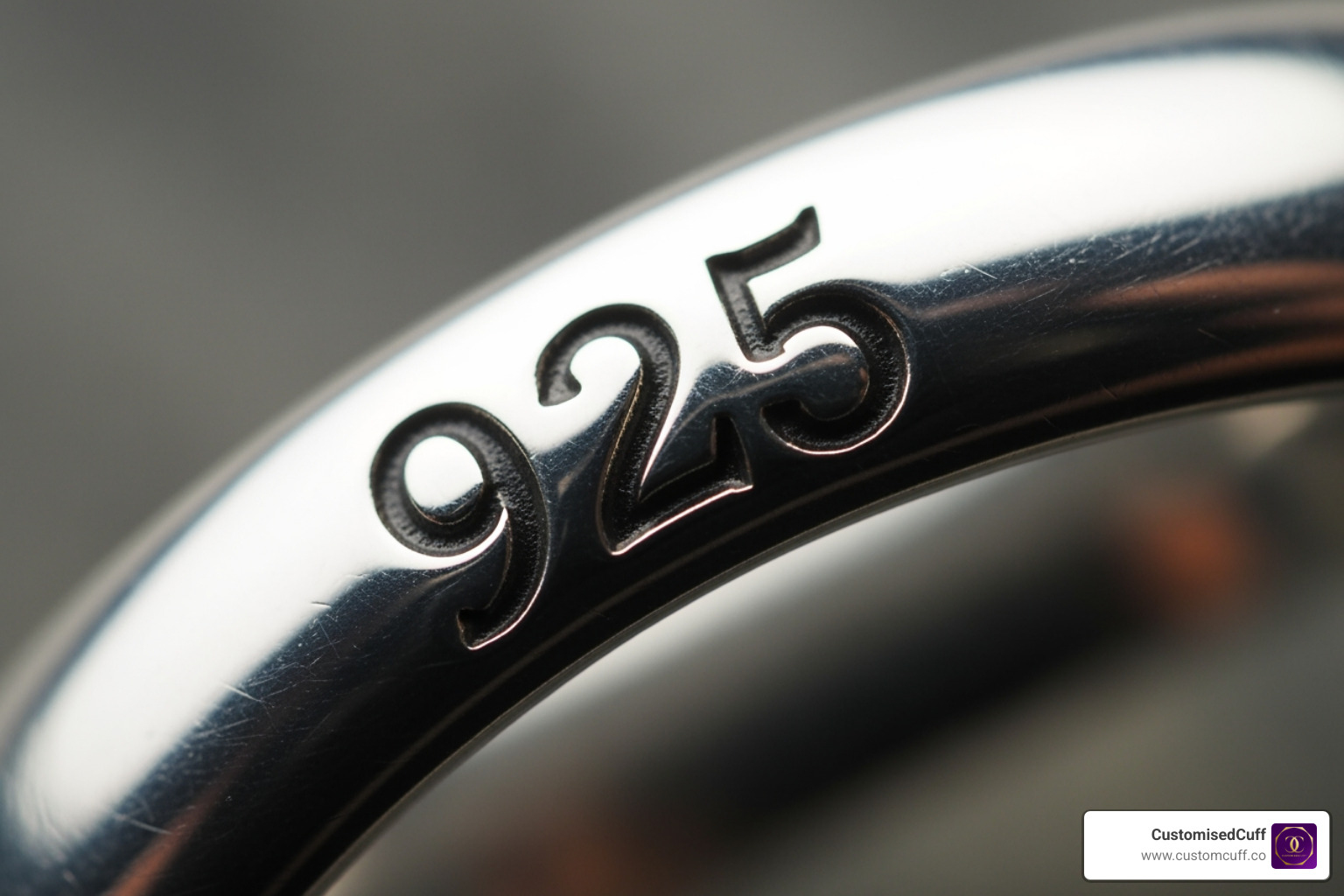
925 engraving on ring is a hallmark that indicates your jewelry is made of sterling silver, an alloy containing 92.5% pure silver and 7.5% other metals (typically copper). This stamp is your guarantee that you're wearing genuine, high-quality silver rather than a cheaper imitation.
Quick Answer:
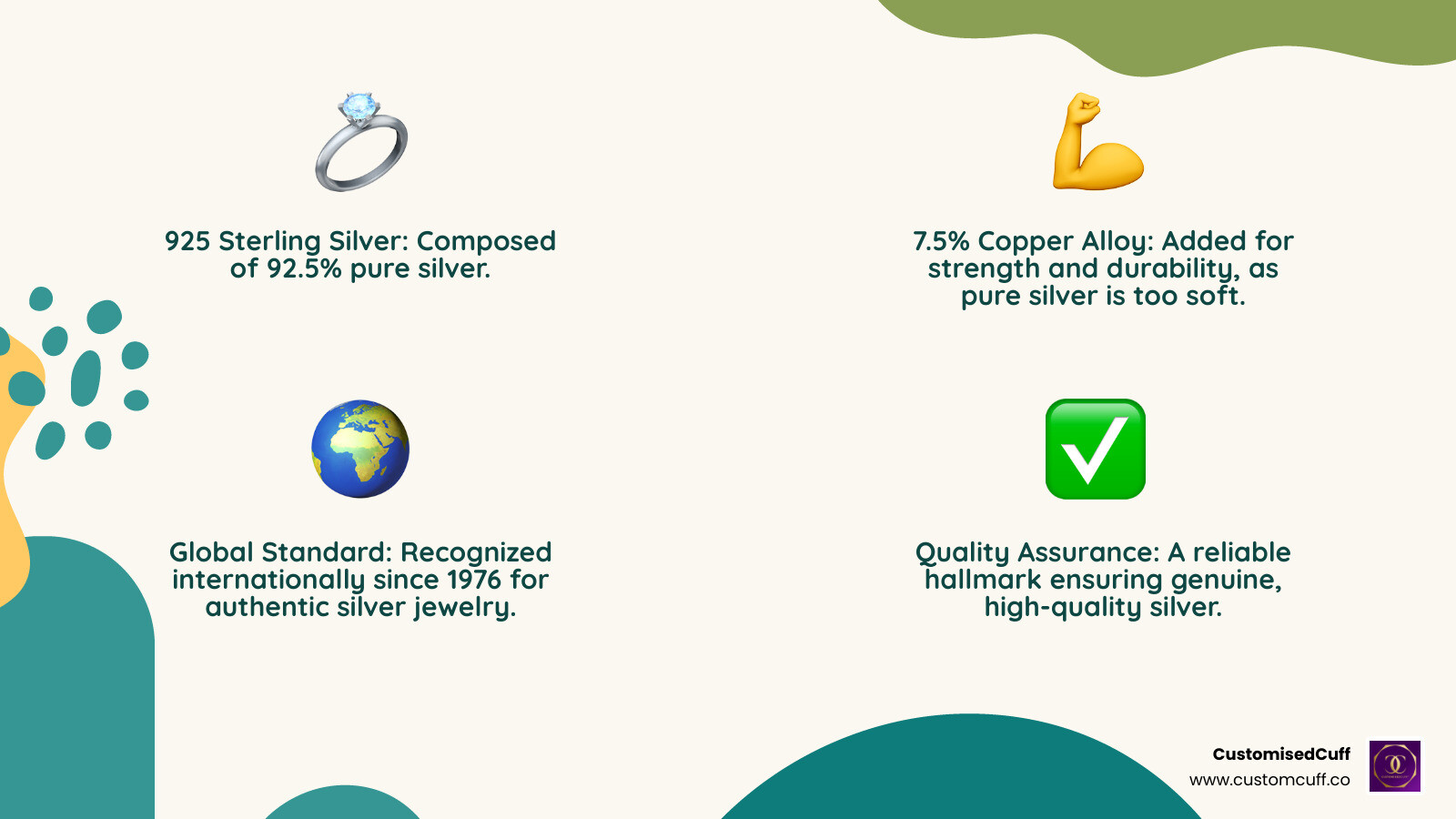
- 925 = Sterling Silver - Your ring contains 92.5% pure silver
- Why Not 100%? - Pure silver is too soft for everyday wear; the 7.5% copper adds strength
- Global Standard - Recognized internationally since 1976 as the mark of authentic silver jewelry
- Quality Assurance - This hallmark protects you from plated or fake silver products
You've probably spotted this mysterious three-digit number stamped inside a ring band or on the back of a necklace clasp. Maybe you received a beautiful piece of jewelry as a gift, or you're shopping for something special to commemorate a milestone. Either way, understanding what that tiny "925" means helps you make confident decisions about the jewelry you buy and treasure.
The sterling silver standard dates back to medieval England, where it was developed to create coins and jewelry that balanced purity with practical durability. Today, it remains the most trusted mark for silver jewelry worldwide, adopted officially by the United States in the 1970s and recognized internationally since 1976.
I'm Suchi Jain Saxena, founder of CustomisedCuff, where I've spent years helping customers understand jewelry quality and create meaningful pieces featuring 925 engraving on ring designs. My journey from Silicon Valley to building a multi-million dollar personalized jewelry business has taught me that educated customers make the most confident gift-givers.
Basic 925 engraving on ring vocab:
Decoding the 925 Engraving on Ring and Its Significance
When we talk about a 925 engraving on ring, we are talking about the "gold standard" of silver. In the jewelry world, silver in its 100% pure form is actually quite a diva—it’s incredibly soft, prone to bending, and can lose its shape just by being worn daily. To make it functional for those stunning signet rings or delicate bands we love, we have to toughen it up.
By mixing 92.5% pure silver with 7.5% of a base metal—usually copper—we create "Sterling Silver." This alloy keeps the lustrous white-grey shine of silver but adds the muscle needed to survive your daily routine. Whether you're typing away at a desk in New York or enjoying a coffee in London, your sterling silver ring stays round and secure.
To help you understand how this compares to other silver types you might encounter in vintage shops or while traveling, we’ve put together this handy comparison:
| Silver Type | Marking | Silver Content | Common Uses |
|---|---|---|---|
| Sterling Silver | 925 | 92.5% | High-quality modern jewelry |
| Coin Silver | 900 | 90.0% | Antique US coins and vintage jewelry |
| European Silver | 800 | 80.0% | Vintage German or Italian silverware |
| Fine Silver | 999 | 99.9% | Bullion bars, investment coins |
If you are interested in how these markings define the character of a piece, check out our More info about stamped signet rings to see how we use these standards to create lasting memories.
What Does the 925 Engraving on Ring Mean for Quality?
Let’s be real: nobody wants a ring that turns into an oval the first time they carry a heavy grocery bag. That is why the 925 engraving on ring is so vital. It represents the perfect equilibrium between beauty and brawn.
Fine silver (marked 999) is beautiful, but it’s just not practical for rings. Sterling silver, on the other hand, is hard enough to hold detailed engravings—like a loved one's handwriting or a specific star map—without those details wearing away after a few months. It’s also hypoallergenic for the vast majority of people, making it a safe bet for those with sensitive skin.
Understanding these stamps is like having a secret decoder ring for your jewelry box. If you've ever wondered how silver markings compare to gold ones, you can read our guide Beyond the Bling: Understanding Your Rings 14K Stamp.
Identifying Maker's Marks and Origin Stamps
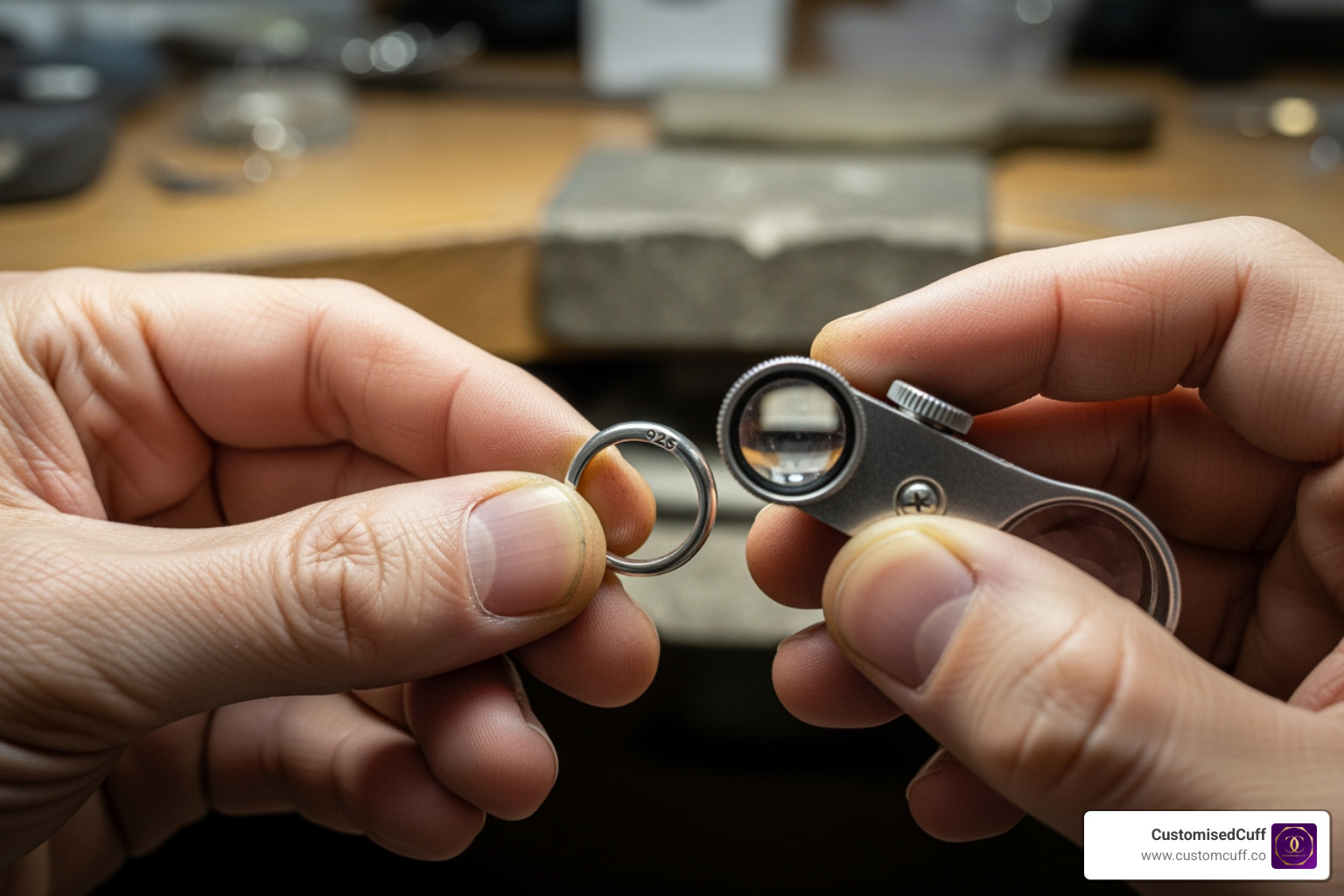
While the "925" tells you what the metal is, other tiny scratches or symbols might tell you who made it and where it came from. These are known as maker's marks or sponsor's marks.
For example, if you see "NVC" alongside a 925 stamp, you’re likely looking at a piece commissioned by Avon in the 1970s. "IBB" often stands for International Bullion, a major manufacturer that ships to the US, Canada, and Europe. In the UK, the system is even more detailed. A legal hallmark there usually includes:
- The Sponsor’s Mark: The initials of the person or company that sent the piece to be tested.
- The Fineness Mark: The "925" in an oval shape.
- The Assay Office Mark: A symbol representing the city where it was tested (like an anchor for Birmingham or a leopard's head for London).
These marks act as a "jewelry passport." For those who love the "detective work" of identifying old jewelry, the Historical evolution of silver marks provides a deep dive into how these symbols have changed over the centuries.
The History and Global Standards of Silver Hallmarking
Hallmarking isn't a modern invention designed to confuse us; it's actually one of the oldest forms of consumer protection! It dates back to the 13th century in England, where King Edward I decreed that all silver items must be tested and marked to prevent fraud.
In the United States, things were a bit more "Wild West" for a while. From the 1860s until the 1970s, most American silver was simply marked "STERLING" or "STERLING SILVER." It wasn't until 1976 that the international community—including the US, UK, and Europe—agreed to use the "925" millesimal expression as the standard. This means that if you find a ring marked "925," it is likely a modern piece (post-1970s), whereas a ring simply marked "STERLING" is likely a vintage treasure.
We love honoring these traditions while adding a modern twist. You can Stamp Your Style: Unique Custom and Personalized Rings with us to create a piece that carries both the weight of history and your personal story.
Understanding Gold-Plated 925 Engraving on Ring
Have you ever seen a ring that looks like solid gold but has a "925" stamp? No, your eyes aren't playing tricks on you! This is often what we call Gold Vermeil (pronounced ver-may).
Vermeil is a high-quality type of gold plating where the base metal is genuine sterling silver. To be called "Vermeil" in the US and many other regions, the gold layer must be at least 10k and a certain thickness. This is a fantastic option because:
- It’s much more affordable than solid gold.
- It’s better for your skin than "fashion jewelry" that uses brass or nickel as a base.
- If the gold plating eventually wears down, you’re still left with high-quality silver underneath.
The Composition of sterling silver additives explains more about what goes into these alloys to ensure they are durable enough to hold that gold plating for years.
Sustainability and Recycled Metals in Modern Jewelry
At CustomisedCuff, we believe that the beauty of a ring shouldn't come at the cost of the planet. One of the coolest things about silver is that it can be recycled indefinitely without losing its quality.
Today, many high-end jewelry workshops use over 85% recycled metals. By choosing a 925 engraving on ring made from recycled silver, you are supporting a circular economy. This ethical approach is becoming the standard across the US, Canada, and Europe, ensuring that your sentimental keepsake is also a responsible one. You can find your perfect, ethically-crafted piece in our guide on Initial Impact: Find Your Perfect Personalized Ring.
How to Verify and Test Your 925 Silver Jewelry
So, you’ve found a ring at a flea market in Madrid or inherited one from a relative in Nevada, but there’s no stamp. Or maybe there is a stamp, but you want to be 100% sure. How do the pros do it?
Professional jewelers use a few different methods:
- The Magnet Test: Silver is non-magnetic. If your "silver" ring jumps toward a strong magnet, it’s likely a base metal like steel or iron with a thin silver coating.
- The Nitric Acid Test: A tiny, discreet scratch is made on the piece, and a drop of nitric acid is applied. If the liquid turns creamy white, it’s sterling silver. If it turns green, it’s a fake or heavily plated.
- The Weight and Feel: Silver has a specific "heft." It feels more substantial than aluminum or plastic but isn't as heavy as lead. It also warms up quickly when held in your hand.
Verification is especially important when you’re planning something as permanent as an inscription. You can explore The Art of the Inscription: Ideas for Engraving Names on Rings once you’re sure your canvas is the real deal.
Common Fakes and Red Flags
The world of precious metals is unfortunately rife with "near-frauds." Here are a few things to watch out for:
- Nickel Silver / German Silver: Don't let the name fool you—these contain zero silver. They are usually a mix of copper, nickel, and zinc. They can cause nasty allergic reactions (the dreaded "green finger").
- Tribal Silver / Tibetan Silver: These are often unregulated and may contain only small amounts of silver mixed with potentially harmful metals like lead.
- Regions to Watch: Some silver from regions like Bali, Mexico, or Thailand may lack hallmarks. While much of it is beautiful and genuine, it’s always safer to buy from reputable sources that guarantee 925 purity.
For a full list of international standards and what to avoid, the guide on Identifying impure silver standards is an essential resource for any serious collector.
Benefits and Care of Your 925 Engraving on Ring
Why choose a 925 engraving on ring over other metals like stainless steel or gold? For starters, it’s the ultimate "accessible luxury." You get the prestige and glow of a precious metal without the mortgage-level price tag of solid platinum.
Sterling silver is also:
- Hypoallergenic: Most people with metal sensitivities can wear 925 silver comfortably because it doesn't contain nickel.
- Timeless: Silver never goes out of style. It looks just as good with a white t-shirt as it does with a wedding dress.
- Customizable: Because it’s a "workable" metal, it’s the perfect medium for Handwriting Rings: Your Finger's Story Engraved Forever.
Maintenance Tips for a Lifetime of Shine
We often get asked: "Why did my silver ring turn black?" Don't panic! This is just tarnish, and it’s actually a sign that your silver is real. Tarnish happens when the copper in the sterling silver reacts with sulfur or moisture in the air.
To keep your ring looking like it just stepped out of our workshop:
- Wear it often: The natural oils in your skin actually help keep silver clean.
- Store it dry: When you aren't wearing it, keep it in an airtight bag or a lined jewelry box.
- Avoid the "Big Three": Keep your silver away from chlorine (pools), bleach (cleaning), and sulfur (found in some eggs and onions—yes, really!).
- Clean gently: A simple soft polishing cloth usually does the trick. For deeper cleans, use mild soap and warm water.
For more detailed care instructions, check out our blog on Engraved Rings.
Frequently Asked Questions about 925 Hallmarks
Is 925 silver real silver?
Yes! It is absolutely genuine silver. It is simply "alloyed" silver. Think of it like 18k gold—it’s not 100% pure because it needs other metals to be strong enough to wear, but it is still considered a precious metal and holds real value.
Why does my 925 ring turn my finger green?
This is a chemical reaction between the copper in the sterling silver and the acids in your skin or the chemicals in your hand lotion. It doesn't mean the ring is "fake." In fact, it often happens more in humid climates or if you've been sweating. A quick tip: a thin coat of clear nail polish on the inside of the band can act as a barrier if you have particularly reactive skin!
Can 925 silver get wet?
Fresh water is generally fine, but we always recommend taking your silver off before hitting the gym, the pool, or the ocean. Saltwater and chlorine are silver’s worst enemies and will speed up the tarnishing process significantly.
Conclusion
At CustomisedCuff, we believe that the jewelry you wear should be as authentic as the stories you tell. Whether it’s a star map of the night you met or a ring engraved with a piece of your grandmother's handwriting, the 925 engraving on ring is the foundation that ensures those memories last.
Understanding the "925" hallmark gives you the power to shop with confidence, whether you are in New York, Spain, or Australia. It’s a symbol of quality, history, and craftsmanship that has stood the test of time.
Ready to start your own story? An Engraved Ring: Perfect Gift is just a few clicks away. We can't wait to help you unveil your ring's true identity!