

10 Breathtaking Starry Night Sky Photos You Need to See
Why the Starry Night Sky Captivates Us All

A starry night sky is a window into the vast universe and, for many of us, a rare kind of silence. One look up can flip a stressful day into perspective, because the night sky feels both personal (you remember exactly where you were) and universal (you are seeing the same stars humans have watched for thousands of years). Whether you are searching for inspiration for a meaningful gift, planning a weekend outdoors, or simply trying to reconnect with nature, the night sky delivers wonder in every direction.
What makes a starry night so compelling is how it mixes science and emotion. Your eyes are catching photons that left their sources years, centuries, or far longer ago, which means stargazing is a form of time travel. It is also deeply human: we use constellations to tell stories, steer oceans, and mark seasons. Even if you cannot name a single star, a dark sky still feels like a shared language.
Quick Guide to Enjoying Starry Night Skies:
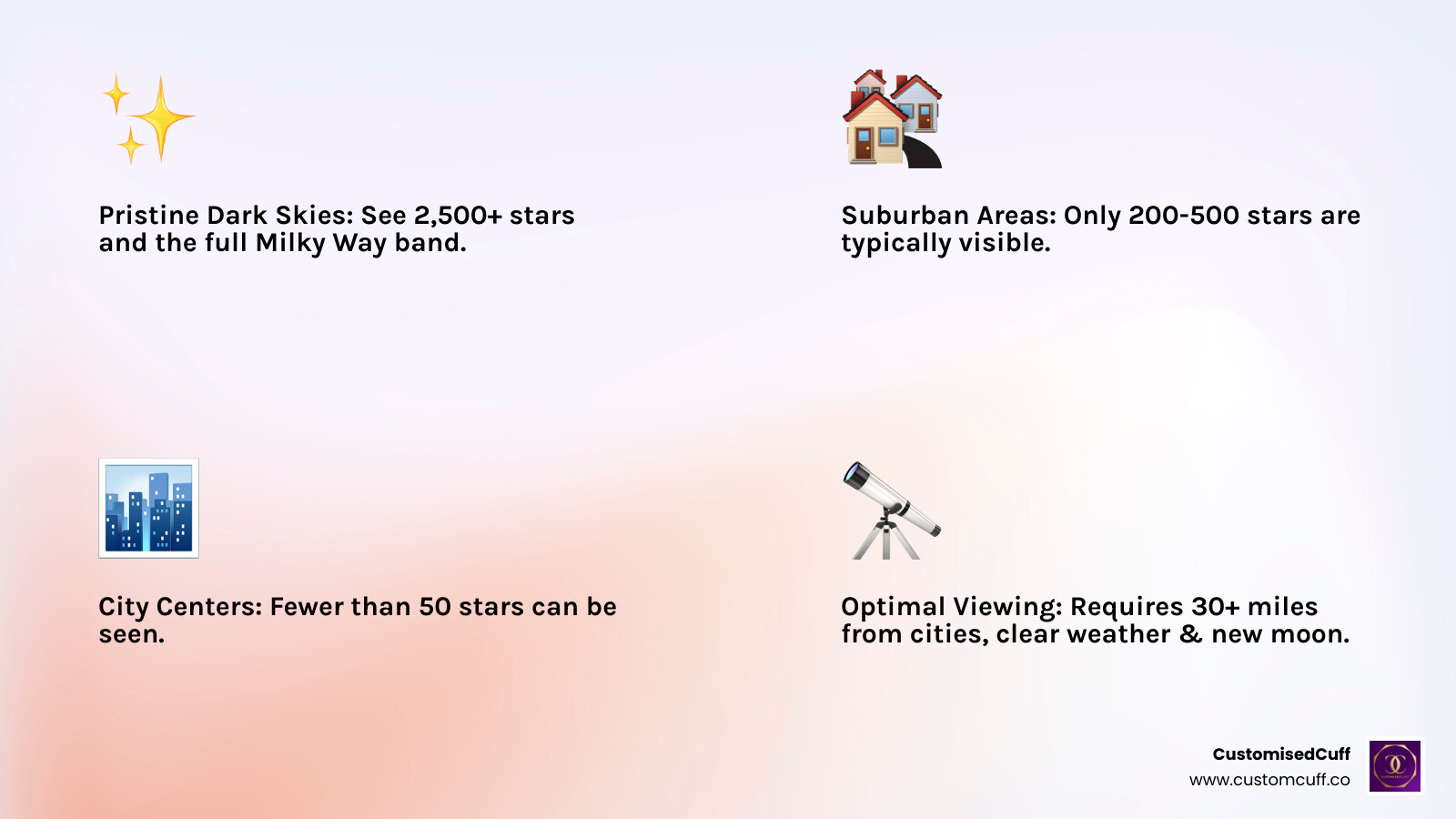
- Best viewing: Darker locations reveal up to 2,500 stars compared to 200-500 in cities.
- What to see: The Milky Way, planets (Venus, Jupiter), meteor showers, and constellations.
- Key facts: Our galaxy has 100-400 billion stars; the nearest star is 4.24 light-years away.
- Top spots: Death Valley, Joshua Tree, and the Atacama Desert.
- Photography: Use long exposure (15-30 seconds) and a sturdy tripod.
A starry night sky has inspired humanity for millennia, from Van Gogh's 1889 masterpiece to modern astrophotography. While light pollution dims the view for 80% of Americans, pristine dark-sky preserves remain transformative. The observable universe contains 2 trillion galaxies, reminding us of our connection to something infinitely larger.
If you want a simple way to level up any stargazing plan, time it right: choose a night near the new moon (or when the moon sets early), check cloud cover, and give your eyes 15-20 minutes to adapt to the dark. Even a small change, like driving 30-60 minutes away from city lights, can reveal the Milky Way on a clear night. A red flashlight helps preserve night vision, and a basic sky app can help you identify bright planets without turning the experience into homework.
I'm Suchi Jain Saxena, founder of CustomisedCuff. We transform meaningful celestial moments into personalized jewelry. Over three years, we've helped customers in 70+ countries capture their precious memories through custom star map pieces. Many of those moments begin with a real night outdoors: a proposal under the Milky Way, a first camping trip, a newborn's "first sky," or a memorial date when someone looked up and felt close to a loved one. Turning a specific sky into a wearable keepsake is our way of helping those stories last.
Explore more about starry night sky:
The Anatomy of a Starry Night Sky

A starry night sky is a symphony of cosmic elements. At its heart is the Milky Way, a spiral galaxy containing up to 400 billion stars. Beyond our home, the observable universe holds an estimated 2 trillion galaxies. For scientific insights, explore Scientific research on the night sky.
Scientific Wonders of the Starry Night Sky
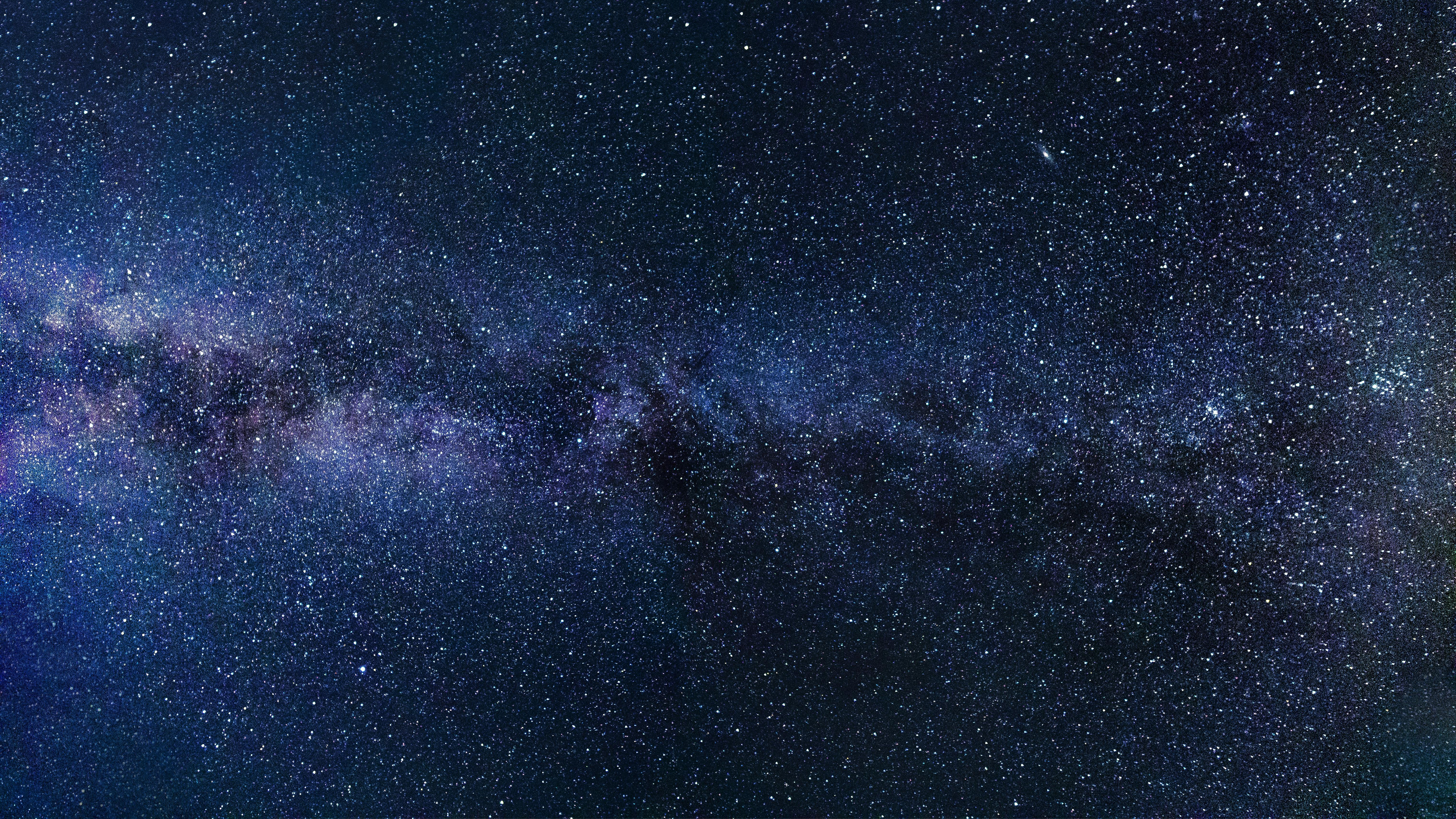
From a dark location, the Milky Way appears as a luminous band of light. We can even see the Andromeda galaxy, 2.5 million light-years away, as a faint smudge. When we look at stars like Proxima Centauri, we are looking back in time, as its light takes 4.24 years to reach us. To steer these wonders, see our More info about constellation spotting.
Celestial Elements and Characteristics
- Planets: Venus, Jupiter, and Saturn shine with a steady light. Venus is often the brightest.
- Constellations: These star patterns serve as cosmic roadmaps.
- The Moon: Its phases change as it orbits Earth, reflecting sunlight from different angles.
- Phenomena: Nebulae (gas clouds) and meteors (shooting stars) add dynamic beauty to the sky.
From Canvas to Camera: The Evolution of Art
Vincent van Gogh's "The Starry Night" (1889) is the most iconic depiction of the cosmos. Painted during his time at the Saint-Paul-de-Mausole asylum, its swirling sky reflects Van Gogh's emotional intensity. Today, it is housed in the Museum of Modern Art. Learn more about the History of Van Gogh's masterpiece.
Symbolism and Moods of the Starry Night Sky
The starry night sky evokes wonder, solitude, and introspection. In art, these moods are amplified. Van Gogh's swirling brushstrokes are often seen as a visual representation of his mental state, while the cypress tree symbolizes the bridge between the earthly and the divine.
Artistic Interpretations Across Cultures
Artistic depictions have evolved from ancient cave paintings to digital photography. Van Gogh transformed real elements, like Venus (the "morning star"), into expressive symbols. Across cultures, stars have represented destiny, guidance, and mythology, from Greek gods to indigenous navigation maps.
10 Iconic Starry Night Sky Photos and Where to Find Them
Modern photography captures details the human eye cannot see. Here are 10 iconic celestial visuals:
- Milky Way Over Mountains: A classic shot of our galaxy's core. Download high-res Milky Way photo
- Star Trails Around Polaris: Shows Earth's rotation over time.
- Aurora Borealis: Vibrant solar particles interacting with the magnetic field.
- Desert Night Sky: Cacti silhouetted against a dense star field.
- Forest Canopy: Looking up through trees at the cosmos.
- Ocean Reflection: The Milky Way mirrored in calm waters.
- Ancient Ruins: Historical structures beneath an eternal sky.
- Tent Under Stars: Symbolizing adventure and escape.
- Enceladus in Saturn's Shadow: A deep-space view from NASA's Cassini.
- Comet Streaking: A rare sight of a glowing tail against the stars.
Top Free Resources for Night Sky Visuals
- Pexels & Unsplash: Offer thousands of high-resolution, free-to-use starry night sky images.
- Wikimedia Commons: A massive repository for public domain astronomical media.
- NASA Science: The best source for scientifically accurate deep-space imagery and "What's Up" skywatching guides.
Striking Deep Space and Landscape Photography
Landscape astrophotography combines Earth's beauty with the majesty of space. Star trails illustrate our planet's motion, while the Aurora Borealis paints the sky in curtains of green and purple. Deep-space missions like Cassini-Huygens provide unique perspectives, such as moons eclipsed by planetary shadows.
Capturing the Cosmos: Technical Tips for Photography
Capturing a starry night sky requires long exposure. By keeping the shutter open for 15-30 seconds, the sensor collects enough light to reveal colors invisible to the eye. A wide-angle lens is essential to capture the broad expanse of the sky. For more, see Unlock the Cosmos: Simple Tips for Stunning Night Sky Images.
Essential Equipment for Astrophotography
- Full-Frame Camera: Better low-light performance and less noise.
- Sturdy Tripod: Essential to prevent blur during long exposures.
- Fast Wide-Angle Lens: Look for f/2.8 or wider and 14mm-24mm focal lengths.
- Remote Shutter: Prevents camera shake when starting the exposure.
- Red Light Headlamp: Preserves your night vision while you work.
Viewing vs. Photographing the Night Sky
Our eyes rely on rod cells in the dark, which see mostly in gray and cannot "collect" light over time. Photography overcomes this using sensors that accumulate photons, revealing the reds of hydrogen gas and the blues of star-forming regions. While direct viewing offers an intimate connection, photography unveils the hidden, vibrant details of the universe.
Global Destinations for Exceptional Stargazing
To see the full majesty of the starry night sky, you must escape light pollution. The Bortle scale measures darkness, with Class 1 being the most pristine. Many regions now host certified Dark-Sky Parks.
Certified Dark-Sky Parks and Preserves
- Death Valley, California: One of the largest and darkest parks in the U.S.
- Joshua Tree, California: Famous for its unique trees and clear eastern skies.
- Red Rock Canyon, Nevada: Offers dark skies surprisingly close to Las Vegas.
- Cherry Springs, Pennsylvania: Renowned as the darkest spot on the U.S. East Coast.
International Stargazing Hotspots
- Europe: The UK (Snowdonia, Exmoor) and the Alqueva Reserve in Spain/Portugal offer incredible views.
- Canada: Jasper and Banff National Parks are world-class Dark Sky Preserves.
- Oceania: New Zealand's Aoraki Mackenzie and various Australian sites offer views of the Southern Cross.
- Mexico & Brazil: Remote regions like Baja California provide clear, dark vistas.
- Qatar: The desert landscapes away from Doha offer impressive clarity for celestial navigation.
These locations provide the memories that CustomisedCuff seeks to immortalize in jewelry.
Frequently Asked Questions about Starry Skies
What is the brightest star visible in the night sky?
Sirius, the "Dog Star," is the brightest. It is only 9 light-years away, which makes it appear much brighter than more distant, intrinsically luminous stars like R136a1.
How can I find the North Star (Polaris)?
Locate the Big Dipper. Follow the two "pointer stars" at the edge of the bowl in a straight line; the first bright star you hit is Polaris. It marks true north and stays stationary in the Northern Hemisphere.
Why does the Moon have different phases?
The Moon reflects sunlight as it orbits Earth. We see different portions of its sunlit side over a 27.5-day cycle. A waning gibbous moon occurs when the illuminated portion is decreasing after a full moon.
Conclusion
The starry night sky is a source of endless wonder and creativity. At CustomisedCuff, we believe these moments deserve to be cherished. We specialize in turning your celestial memories into personalized jewelry, from star maps to zodiac designs.
Explore our Ultimate Guide to Custom Star Map Necklaces or Shop our best-selling celestial collections to find your unique keepsake.